Sanctioned ex-Navy chief Karannagoda arrested over Rajapaksa recruitment probe
Sanctioned ex-Navy chief Karannagoda arrested over Rajapaksa recruitment probe by Thusiyan
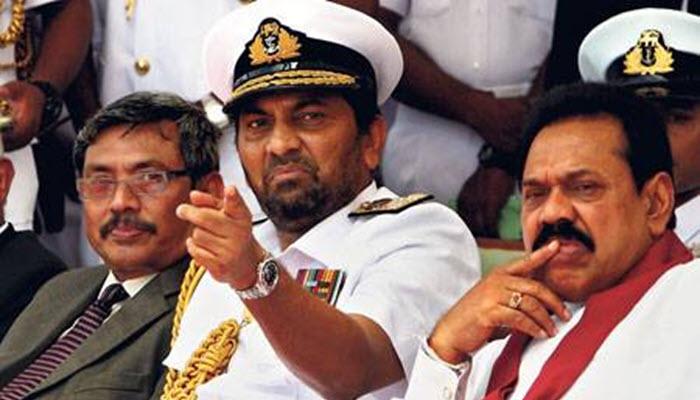
Former Sri Lankan Navy Commander Admiral of the Fleet Wasantha Karannagoda has been arrested by the Commission to Investigate Allegations of Bribery or Corruption over allegations linked to the recruitment of Yoshitha Rajapaksa to the Sri Lanka Navy in 2006.
Karannagoda was arrested at around 10.05am on Friday at the Bribery Commission premises after being summoned to record a statement.
He is due to be produced before the Colombo Chief Magistrate’s Court.
According to local reports, the investigation centres on allegations that standard recruitment qualifications for executive officers in the Sri Lanka Navy were altered to facilitate the enlistment of Yoshitha Rajapaksa, the second son of former Sri Lankan president and accused war criminal Mahinda Rajapaksa.
CIABOC has alleged that Yoshitha Rajapaksa was recruited as a cadet officer in the executive branch of the Sri Lanka Navy despite not meeting the required qualifications for the post.
The Commission further alleges that he was later facilitated to attend training at the Britannia Royal Naval College in the United Kingdom using state funds and outside the established procedures in place at the time.
The alleged actions amount to an offence of corruption, according to CIABOC.
The inquiry also covers whether proper approvals were obtained for the overseas training arrangements and whether public funds were used outside approved financial and administrative processes.
Karannagoda had previously been summoned to appear before the Bribery Commission on 16 June to provide a statement regarding his role in the recruitment process, but did not attend. Local reports said he had stated that he had not formally received the summons.

The same probe has already led to the arrest of Yoshitha Rajapaksa.
Yoshitha was arrested by CIABOC on 17 June after arriving at the Commission to record a statement over his admission to the Sri Lanka Navy and subsequent training in the United Kingdom. The Bribery Commission said he was arrested on charges of aiding and abetting corruption in relation to the incident.
He was later produced before the Colombo Chief Magistrate’s Court and released on bail on three personal sureties of Rs. 5 million each. A foreign travel ban was also imposed on him.
Earlier findings cited by the Commission stated that Karannagoda, as then Navy Commander, had written to the Royal Naval Academy in September 2006 seeking a placement for Yoshitha Rajapaksa. The academy reportedly responded in November 2006, indicating that admission could be arranged but would not be offered on a full scholarship and would require payment.
Investigators have also scrutinised the circumstances of Yoshitha’s recruitment itself. The standard eligibility criteria for cadet officer appointments reportedly required candidates to have completed Advanced Level studies in the science or mathematics streams, while Yoshitha had studied in the arts stream. The Commission alleges that recruitment criteria were later revised and fresh advertisements issued in a manner that enabled his appointment. Concerns raised over his Ordinary Level qualifications were also allegedly resolved through changes that corresponded to his academic record.
Yoshitha travelled to the United Kingdom in January 2007 and trained at the Britannia Royal Naval College for more than eighteen months, with the costs reportedly borne by the Sri Lankan state.
The corruption investigation has revived scrutiny of the privileges enjoyed by the Rajapaksa family during Mahinda Rajapaksa’s presidency, when state institutions and the armed forces were repeatedly accused of being used to serve the political and personal interests of the ruling family.
Karannagoda’s arrest, however, also exposes a deeper contradiction in Sri Lanka’s approach to accountability.
While he has now been arrested over an alleged corruption offence involving Yoshitha Rajapaksa’s naval recruitment and foreign training, he has long evaded accountability for far more serious allegations linked to abduction, torture, enforced disappearance and murder.

Karannagoda was named as the 14th suspect in the Navy 11 case, involving the abduction and presumed murder of eleven young men, most of them Tamil, between 2008 and 2009.
The victims were abducted from Colombo and surrounding areas, held for ransom at naval bases including Trincomalee and Colombo, and later disappeared. The eleven victims have been named as Kasthuriarachchi John, Thyagarajah Jegan, Rajiv Naganathan, Soosaipillai Amalan, Soosaipillai Roshan, Kasthuriarachchi Anton, Prageeth Vishvanathan, Thilakeshwaran Ramalingam, Mohamed Dilan, Mohamed Saajid and Ali Anwar.
In 2019, the International Truth and Justice Project released a report titled The Sri Lankan Navy: A Collective Blind Eye, documenting a wider pattern of abductions, torture and enforced disappearances allegedly carried out by the Sri Lankan Navy and other security forces.
The report identified Karannagoda, who served as Navy Commander from 2005 to 2009, as a key suspect.
Despite that, Sri Lanka’s Attorney General announced in 2021 that charges against Karannagoda would not proceed, drawing condemnation from victims’ families and human rights organisations.
After the charges were dropped, Karannagoda was appointed Governor of the North Western Province by then Sri Lankan president Gotabaya Rajapaksa, further fuelling anger over Sri Lanka’s entrenched impunity for senior military figures.
The United States barred Karannagoda and his wife from entering the country in 2023, citing his involvement in a gross violation of human rights. US Secretary of State Antony Blinken said at the time that the allegation Karannagoda had committed a gross human rights violation, documented by NGOs and independent investigations, was “serious and credible”.
Britain sanctioned Karannagoda in March 2025 under its Global Human Rights sanctions regime, imposing travel bans and asset freezes.
The UK government said Karannagoda was responsible, under command responsibility, for serious human rights violations committed by the Sri Lankan Navy during the period in which he served as commander, including illegal killings and acts amounting to torture or cruel, inhuman or degrading treatment.
For years, Karannagoda was protected from prosecution over the Navy 11 case and celebrated by the Sri Lankan state as a war hero, despite allegations that naval units under his command abducted young men for ransom and murdered them.
மேலும் படிக்க »
இந்த செய்தியைப் பற்றிய கருத்தை பதிவு செய்யுங்கள். மேலும் இந்த செய்தியை உங்கள் நண்பர்களுடன் பகிர்ந்து கொள்ளுங்கள்.